
The situation
A regulated or multinational business must keep certain data in a given region or cloud, under its own keys, while the rest of the business runs on a global platform. Today that means separate buckets, separate pipelines and a compliance review per application.What OneBucket changes
The rule is written once, at the layer, per bucket. A sovereign bucket is mapped to EU backends under your keys; the global bucket goes wherever policy says. Replication adds copies where they are required. Applications and agents still use one endpoint, and backend keys stay with you.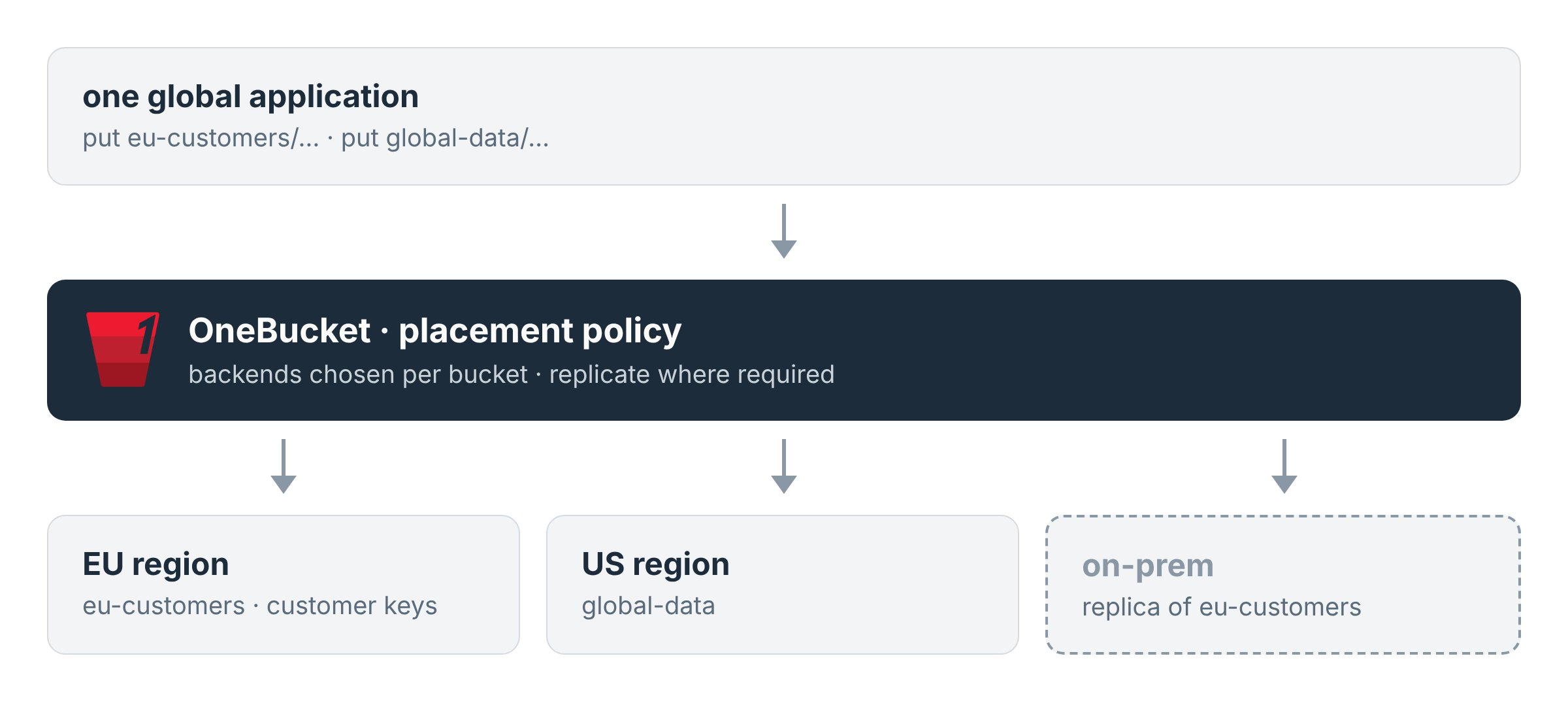
How it works
- Per-bucket placement. A policy maps a OneBucket to its backends and its replication targets. Placement is set per bucket, not per object: objects are not routed individually by prefix or tag.
- Keys stay with you. Each backend is registered with its own credentials, held in the secure vault. Customer-managed keys remain customer-managed.
- Proof of location. The
locatetool returns where any object physically lives, which is what an auditor wants to see. - Regions. OneBucket runs clusters in multiple regions. Global hostnames route each request to the nearest cluster; pin a cluster when requests must land in one place.
Related
- Set up your OneBucket
- Write once, land in several clouds
- Migrate behind a fixed endpoint when the move is a cloud exit for sovereignty reasons